









Agriculture grew by 2.6 percent in 2025, the slowest of the three sectors highlighted in the World Bank’s Liberia Economic Update. [1] Yet farming remains where many Liberian households earn a living. If recovery finance is to reach families, it must work along the chains that turn what Liberians grow and catch into what Liberians buy.
Follow the rice
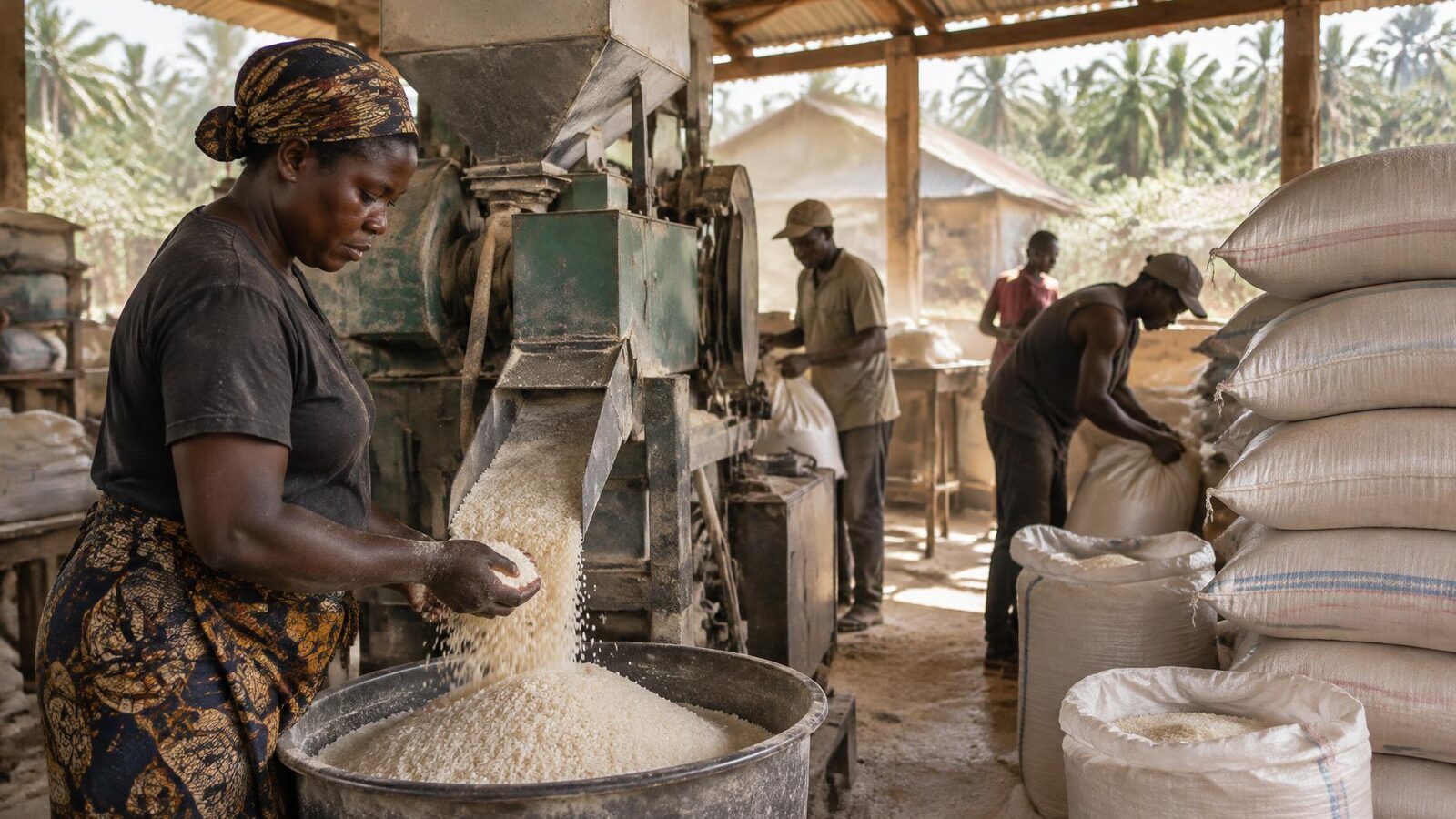
A rice farmer harvests paddy. If no buyer arrives, or the road is impassable, the paddy waits—and loses value. A mill nearby could buy it, but only if the mill has working capital to pay at harvest, equipment that runs reliably and power to run it. The mill then needs a buyer for milled rice: a wholesaler, a school-feeding programme, a supermarket.
Each link has a financing need. The farmer needs inputs before planting and is paid once, after harvest. The mill needs equipment and cash for purchasing. The buyer needs confidence in consistent quality and supply. A loan that ignores this rhythm—demanding monthly repayments from a farmer with a single annual income—will fail.
Follow the fish
Fish brings the same logic with less time. Catch landed on a beach must be iced, stored or processed within hours. Without cold storage and power, a share of the catch spoils, and the fishers selling it take whatever price the market offers that day.
Tools that fit the chain
Today’s Liberia™ proposes that recovery finance for production use tools designed for these patterns.
Equipment leasing. Mills, dryers, ice machines and cold rooms can be leased, with the asset itself serving as security. This avoids requiring land titles that many producers cannot provide.
Seasonal repayment. Loan schedules should match harvests and fishing seasons, not calendar months.
Verifiable offtake. Lending is safer where a buyer has committed in writing to purchase output at agreed terms, and that commitment can be checked.
Power and feeder roads. Finance cannot replace infrastructure. In the 2025 Enterprise Survey, 21.6 percent of firms cited electricity as their biggest obstacle and 91 percent owned a generator. [2] A cold room on unreliable power, or a mill at the end of a road that floods, is a loan at risk. Public investment in feeder roads and reliable supply should be planned alongside the credit.
Who captures the value
Finance can strengthen a chain or concentrate it. If only the largest processor can borrow, farmers may gain a buyer but lose bargaining power. Programme design should ask who sets prices, whether small producers are paid promptly and in full, and whether cooperatives can participate on equal terms.
Measure what matters
Success should not be measured by loan volume. Today’s Liberia™ proposes three plain indicators, published for each supported business: the value of purchases from Liberian farmers and fishers; the share of product lost to spoilage, before and after support; and the number of workers on payroll and wages paid.
These are measurable, and they connect finance to households. If the numbers do not move, the money is not doing its job, however much of it is lent.