









A persuasive agricultural deck connects the harvest to the buyer and the revenue to a sustainable operation.
Liberia’s agricultural ambitions deserve a stronger commercial presentation than an appeal to cultivate available land. Land can support production, but it does not explain how an enterprise will make money. Investors need a credible connection between farmers, processing capacity, distribution and paying customers.
That connection should be the center of an agricultural pitch deck.
A proposed rice-processing business, for example, should begin by defining its market. Who would buy its output? What product specifications do those buyers require? How do price, packaging, reliability and delivery compare with competing products? Expressions of interest can help establish a conversation, but they must not be presented as binding purchase commitments.
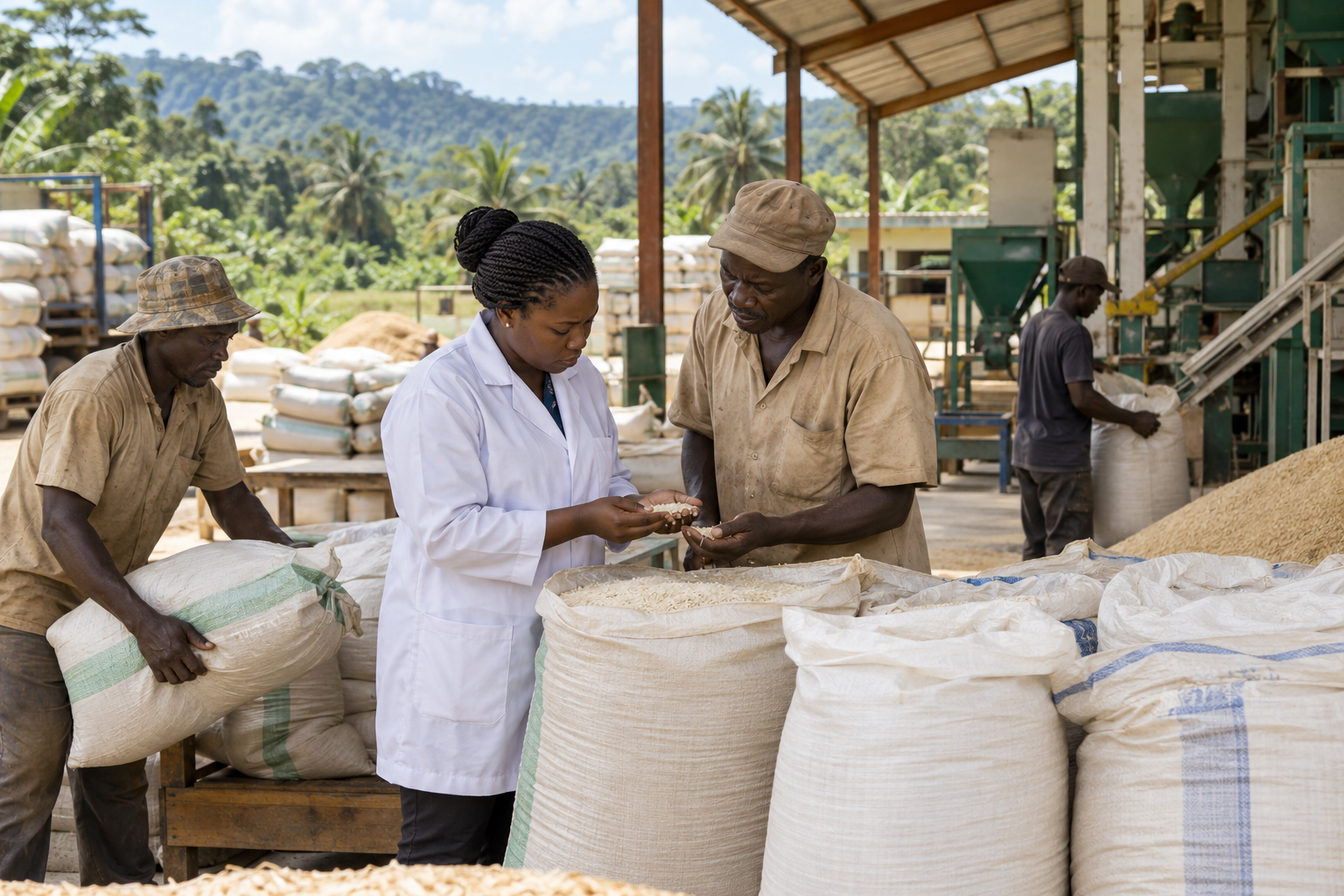
The next question is supply. A processing plant needs more than equipment. It needs enough suitable raw material, delivered consistently and at a cost the business can sustain. The project should document its proposed sourcing arrangements, seasonal variations, transport requirements, quality controls and payment terms for farmers.
Only then does installed capacity become meaningful. A facility capable of processing a large volume may operate far below capacity if supply or demand is weak. Financial projections should therefore explain expected utilization and test what happens when production ramps up more slowly than planned.
Using the Liberia Investment Gateway approach, an agricultural project could be presented as a county-specific business with a traceable evidence record. Its pitch would identify the operator, proposed site, land arrangements, supplier network, customer pipeline, equipment budget and working-capital requirement. Each claim would have a source, a date and a stated verification status.
Community participation also belongs in the commercial case. Land access, consultation, farmer relationships and environmental safeguards affect whether an enterprise can operate reliably. Treating these matters as paperwork to be completed later creates uncertainty for both communities and investors.
The financing request must separate construction and equipment costs from the money required to buy inputs, pay staff and carry stock before customers pay. A business can have a finished factory and still struggle because its operating cycle was underfunded.
For illustration, a proposed aggregation and processing hub could seek an operating partner first, fund feasibility and sourcing work next, and approach construction financiers after demand and costs are sufficiently established. That sequence would depend on the project; it is not evidence that an actual hub is ready for financing.
The customer must appear before the factory
For an illustrative agricultural hub in Lofa or Bong, the first research assignment would be interviews and documented discussions with potential buyers. Wholesalers, shops, food businesses and institutional purchasers may have different needs. The sponsor would have to determine the product, acceptable quality, order frequency, credit terms and delivered price. Those findings would influence equipment choices and the size of the facility.
National demand is useful background, but a new supplier still has to win customers. A market can be large while a particular enterprise struggles to compete. Reliable quality and delivery may matter as much as the lowest advertised price. A pitch should explain the specific advantage the proposed business would offer.
A real example of a specific financing proposition
IFC's published project disclosure for Liberian American Poultry and Modern Mills of Liberia describes a proposed sustainability-linked loan of up to US$30 million. It identifies the businesses and proposed expansion activities in poultry and flour milling.[3] The disclosure illustrates the difference between promoting a sector and describing a transaction. It should not be read as proof that funds have been disbursed, or as a Gateway-supported deal.
The lesson is specificity: a defined borrower, an amount, an instrument and a use of proceeds. A smaller Liberian enterprise can apply that discipline at its own scale without imitating the size of the proposal.
The cash cycle behind the harvest
Agricultural working capital deserves a slide of its own. A processor may pay farmers promptly while its buyers pay later. Cash is tied up in raw material, processing, packaging and finished stock. Seasonal purchases can make that requirement larger even when annual revenues look attractive.
The financial model should trace those movements month by month. It should also account for rejected produce, storage losses, transport interruptions and customer arrears. Profit on paper cannot settle wages or purchase the next delivery of crops if the money is still owed by a buyer.
Supplier arrangements need equal care. Farmers should understand quality standards, weighing practices, payment timing and how disputes are handled. Predictable terms can improve the enterprise's sourcing reliability while helping producers plan. The sponsor should avoid promising farmers benefits that its model cannot sustain.
A financing path that follows the evidence
A practical sequence could start with a limited sourcing and sales pilot, followed by a costed design and independently reviewed feasibility work. The results would determine whether to expand, redesign or stop. A pilot is useful precisely because it can expose a weak assumption before construction consumes a larger amount of capital.
The next presentation would report what the pilot demonstrated and what it did not. Procurement quotations, buyer discussions and production records should be dated. Land and community arrangements should be reviewed separately from the financial forecast. The investment request would then reflect the actual stage of preparation.
Public support can help with research, training and enabling infrastructure, while private sponsors take responsibility for the enterprise. Where assistance is proposed, its source and conditions should be stated. An application for support is an unresolved dependency until a commitment exists.
The next decision
Liberia’s agricultural pitch should show how value moves through the business—and how farmers share in that value. A persuasive deck connects the harvest to the buyer, the buyer to revenue, and the revenue to a sustainable operation.