











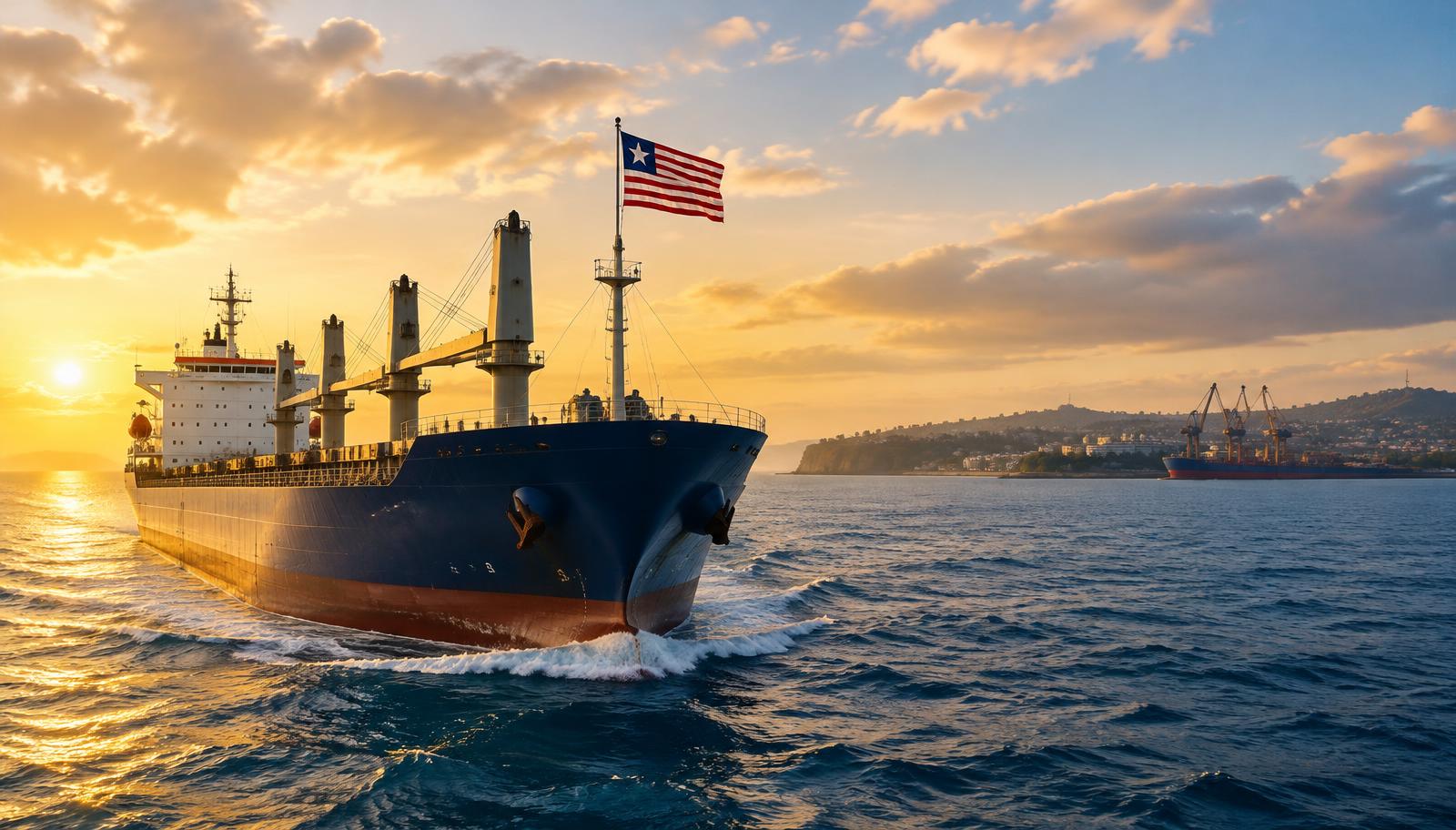
Liberia’s flag travels much farther than its domestic maritime economy. Ships registered under its laws connect producers, consumers and ports across the world. The policy question is whether more of the work supporting those vessels can create opportunities for Liberians at home.
The Liberian Registry reported approximately 6,200 vessels and 320 million gross tons in September 2026.[1] That scale provides an international commercial network. It does not establish that the vessels are owned by the Liberian government, that their freight earnings belong to Liberia, or that they call at Liberian ports.
The strongest opportunity is to turn flag registration into a maritime services industry that creates jobs and taxable domestic activity. It requires a practical offer to shipowners: reliable people, competitive services, secure systems and an operating environment in which relocating a function makes commercial sense.
Ask what work can come ashore
A maritime office is valuable when it performs a function. A nameplate and a receptionist may satisfy a superficial presence requirement while creating little expertise or revenue. A team handling purchasing, records, compliance support, financial administration or crew coordination can develop skills and relationships that last beyond a single registration.
Liberia should begin by asking fleet operators which activities they could commission locally. Accounting support might be feasible earlier than complete technical ship management. Training administration may be easier to establish than a major repair yard. These choices should follow customer interviews, qualifications and cost assessments rather than a predetermined list of buildings to construct.
Owners also need dependable communications, power, business banking and access to competent staff. A service center that loses connectivity during a time-sensitive transaction can impose costs far beyond its own fee. National ambition must therefore be matched with service standards and redundancy.
An office requirement needs a legal foundation
The registry permits non-Liberian businesses to register as Foreign Maritime Entities for vessel ownership.[2] Registration and a staffed domestic operating office are different arrangements. A new office mandate would need examination of the current maritime and corporate framework, the authority to make registration conditions, and the rights and obligations under existing agreements.
A proposed percentage-of-earnings charge raises additional questions. Which company would pay: the registered owner, charterer, operator or manager? Would the calculation use gross freight receipts, adjusted revenue or profit? Which costs would be deductible? How would the government verify transactions between associated companies?
Liberia’s Constitution assigns taxation powers to the Legislature, with revenue bills originating in the House of Representatives.[3] A new levy should follow the applicable legal process. A physical office also does not automatically make all worldwide earnings taxable in Liberia; the current rules governing residence, permanent establishments, exemptions and income sourcing require specialist review.[4]
Before imposing either requirement, Liberia should commission a legal review of current maritime and tax laws, registry-management agreements and applicable treaties, alongside a commercial assessment of how owners would respond.
Know which money belongs to whom
Revenue discussions often collapse several distinct businesses into a single number. Registry fees are paid for registration and related services. Shipping companies earn freight or charter income. Port operators charge for domestic services. The government receives taxes, fees and transfers according to their governing rules.
Those flows overlap, but they are not interchangeable. Adding a registry’s gross collections to the transfer made from those same collections would count part of the money twice. Adding a company’s revenue and its employees’ wages would also overstate the combined value if the wages were paid from that revenue.
The FY2025 government accounts report US$14 million on the maritime revenue line. A separate US$6 million Maritime-DCO contingent item had no realized collection.[5] These figures establish identifiable public-account entries. They do not reconstruct the registry’s total bills, operating costs, retained funds or contractual distribution.
That distinction should be central to public scrutiny. Liberia needs a reconciliation from charges billed to cash collected, authorized costs, contractual allocations, public remittances and closing balances. Publishing that reconciliation would support informed debate without treating an unverified gap as proof of wrongdoing.
Build a services proposition investors can evaluate
An initial maritime business-services hub could be organized around contracts rather than compulsory occupancy. Its pitch would identify the customer, service, management team, staffing requirements, technology, quality controls and financing need. Potential buyers would test the service through paid pilots, with clear performance expectations.
The Liberia Investment Gateway approach is relevant here as a method of preparing specific opportunities. A project should disclose its evidence and remaining gaps. A proposed training business needs approvals and placement partners. A supplier center needs purchase demand. An office development needs credible tenants. The country’s fleet headline cannot substitute for those commercial facts.
Government could support the enabling environment and transparent procurement. Private operators would remain responsible for sales, execution and financial performance. Incentives should be lawful, published and linked to measurable activity, with their fiscal costs evaluated against additional benefits.
Protect the asset while expanding its value
A new burden could influence owners’ flag choices. The extent of that response is unknown and should be studied, not assumed. Liberia needs to understand retention, price sensitivity and competing offers before designing a universal contribution.
Registry quality also remains essential. Safety oversight, credible enforcement and timely service protect the flag’s standing. Domestic participation should strengthen those capabilities rather than displace them with less capable providers.
A practical first year would commission the legal and financial reviews, consult owners, select a few viable service functions and launch measured pilots. Results would include paid contracts, qualified employment, actual local procurement and taxes collected. Announcements and office registrations would be intermediate steps.
Liberia should aim to be a place where maritime work gets done. The most durable gains will come when the flag connects international customers with a domestic workforce able to serve them reliably.
Linked sources
- [1] LISCR, “Liberian Registry Supports Strengthened Flag and Port State Cooperation with China MSA,” September 21, 2026. Fleet figures are registry-reported.
- [2] LISCR, Corporate Entities, Foreign Maritime Entity section.
- [3] Constitution of the Republic of Liberia, Article 34; text hosted by UNHCR Refworld.
- [4] Liberia Revenue Code, sections 801–805 in the published compilation, read alongside subsequent amendments; LRA’s April 7, 2026 notice describes further changes to permanent-establishment and income-sourcing rules.
- [4] Liberia Revenue Code, sections 801–805 in the published compilation, read alongside subsequent amendments; LRA’s April 7, 2026 notice describes further changes to permanent-establishment and income-sourcing rules. — additional reference
- [5] MFDP, Government of Liberia Annual Consolidated Financial Report FY2025, explicitly unaudited; Table 11, printed p.27, and Table 43, printed p.48. Tables use thousands of US dollars.